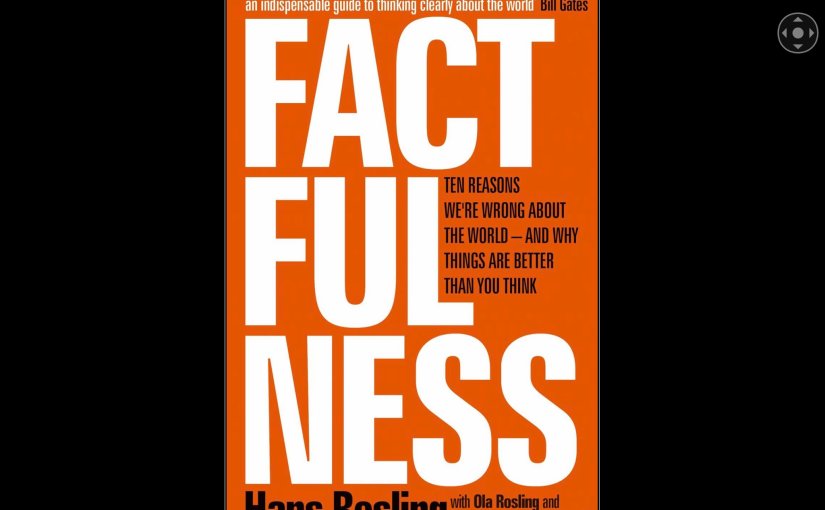
One book I found fascinating is “Factfullness” by the late HansRosling, Ola Rosling & Anna Rosling. The book which persuades us to look at the bright side of the World we live in. While I read this book a couple of years back I am still going ahead and posting on my blog as this is one of my favourites.
The book is all about asking us to look at the World we live in holistically and compare the present to what was over a period of time, Of course there are many problems but we seem to be focussed only on the negatives and not looking at the positive changes we have had in many spheres of our lives.
If we were to look at education, globally the literacy rates and people enrolled in schools has gone up – barring a few exceptions! And we seem to be focussed on these exceptions alone! I must confess I did not know and, therefore was pleasantly surprised, to see the gender gap narrowing!
in the past few years.
The other aspect is the gap between fact and perception and this is no less aided by the media in building and amplifying stereotypes. I remember reading an article that showed how crime reporting increased by >600% making it look like incidences of crime were exponentially growing while in reality there was a reduction of murders per 000k of population. while there are pockets and specific events – terrorism, COVID 19 pandemic and the current Russo-Ukraine war – at an aggregate the World is a great place and it is about looking at those positives and trying to lead a more fulfilling life. And if each of us were to pick up the good then we can Truly make this planet a great one.
Taking cues from the book and Covid 19 as a case in point, there are quite a few learnings. While the pandemic, which is a once in a 100-year event, has caused quite a disruption across the globe it is important to look at event based reporting which is a serious issue too. The sudden spurt of cases and the global disruption has meant that reportage too was significantly up but the way things gotportrayed of events in India was clearly beyond acceptable and, if I may say, irresponsible. Two points here – a. the pace and success of the vaccination programme was even more out of the ordinary but the positive news that it is was nowhere comparable to all the bad news in reporting terms b. The response That we have should be replicated to other issues like say TB incidences & deaths and fatalities due to road accidents in India – with >2.5 mio cases & >450K deaths TB is a far bigger problem to solve for and with just over 1% of the world’s vehicles India accounts for ~6% of Accident based deaths (~150k) – so TB + deaths due to accidents = 1,600 deaths/day – the current action we have taken on tackling #COVID19 should be used as a learning to handle equally important and systemic issues.
While I knew it was important one area that is now ingrained in my thinking after reading the book is to always look for data over a period of time rather than rely on data at a given point in time; Data needs to be viewed not just over a period of time but also with other aspects such as seasonality. A simple example is to look at revenue growth over 3 years would tell us how sustainablean organisation’s growth is as against looking at growth for a year. Similarly, if we were to look at a 3-year growth for countries we will realise how in 2020 Covid did affect countries but when viewed for the next year it will also tell how countries are reacting economically.
Overall, Factfulness is a great read and one which implores everyone to look at data and the positive aspects of life and, hopefully, will make more people optimists. BTW clearly I am better than the chimps as I outscored them by answering twice as many questions correctly in the book…

 Nidugondi Speak