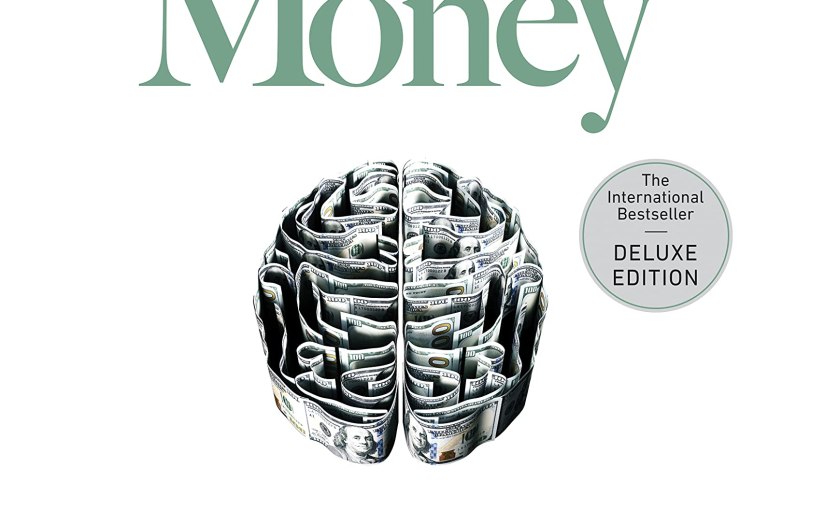
Psychology Of Money – My Views

Ever so once in a while a  self-help/management book is not just engrossing but something you can relate to with the author – and psychology of money by Morgan Housel is one such book. While I did hear of this book being quite a success I had a big backlog of books and so it took a while to get to this one.

At the outset I must confess what I expected and what the book turned out to be was totally different but must admit it was much better and enjoyable than what I anticipated – for anyone wanting tips on how and where to invest this is not the book but if one wants to get views on how to look at money and wealth there are a lot of fantastic perspectives to assimilate.  

Here are a few callouts and takeaways

The example of Bill Gates and two of his friends best describes the role of chance and luck – apart from, of course, hard work, innovation, creative thinking et al. It was about one in a million) or something in that range) chance that Gates and his friends were the select few to have studied in a school that had a computer and one of the friend died in a mountain accident which in itself was   a remote possibility. So here was chance that two of them made it big and the other – who was regarded to be equally good – not seeing to light an organisation that disrupted the industry.  

Continuing the thoughts on luck and risk, the author mentions that studying either people who made it big or some disastrous examples is probably not the right approach as there could be multiple factors including chance and context; so studying broad parameters is much better which, in a sense, takes out some of these extremes.  The point that The line between foolishness and great moves could be a mm thick will stick with me for a while. An extension to the above is where the author expands to say that time, place and context play a major role   and who can disagree with the statement that “everyone who is successful is not hard-working and anyone who is poor is not lazy”!

In terms of money and satisfaction the statement “One who is in control of his/her time is happiest” is profound and cannot be truer. The statement by Joseph Heller when told that a hedge fund manager made  more money in a day than the sales of his book Catch 22   that he had one thing that the hedge fund manager did not have – enough – simply wow! Continuing this theme, the best example is about how Rajat Gupta and Rajaratnam threw away power and money and Warren Buffet puts it best that why throw away everything for what you don’t have and need to what you have and need.

One more gem from the book is about how modern capitalism generates wealth and envy. The ceiling of social comparison is so high virtually no one will ever hit it and the only way to win is not to fight to begin with and accept we have enough even if it is less than what others have around you.

Probably one of the three real pieces of advice is about how money compounds and so it is all about investing early and for a long time. The illustration of glaciers was nice and even better how Warren Buffet would have been 99% less rich had he started at 30 instead of 10 and retired at 60 – the power of compounding at its best. If I am not wrong Albert Einstein said something akin to compounding to be the most powerful thing.

The second piece of advice is about how getting wealthy and staying wealthy are two different things and while for the former we may need to be aggressive but for the latter to be true it is about being conservative. While many may disagree I found the statement “being wealthy is not having those diamonds…” quite interesting. The final piece of advice is taking a portfolio approach and it is about a small portion giving an inordinate return.

Whenever I listen to the views of analysts recommending specific stocks or asset classes I always wonder as to who the persona being addressed to is and that is exactly what the author says   that there is no one recommendation as someone for the long term would have different goals to that of a day trader.

A few more gems in the book

• We make mental models and live with those – most important to note is we don’t know a lot.

• Why do people like to believe in forecasts – because people want to believe that we live in a predictable controllable world and we look to authoritative sounding people to satisfy that need.

• risk is what is left over when you think you thought of everything!

• The illusion of control is more persuasive than the reality of uncertainty.

One point that I want to dig deeper is the concept of “margin for error”, which will help in managing risks better.

Now towards the end of the book is where the author resonated the most with me. His views in life about The ability not to be flashy and be humble; Not wealthy but to be independent – independent to decide what I want to when I want to – are things that I fully subscribe to but to get to the latter point guess I am still a few years away!

I will not be overstating the point when I say that the independence to choose what we want to    do in life and being in control of time is absolutely prime for me and this book has just made that clearer to me…
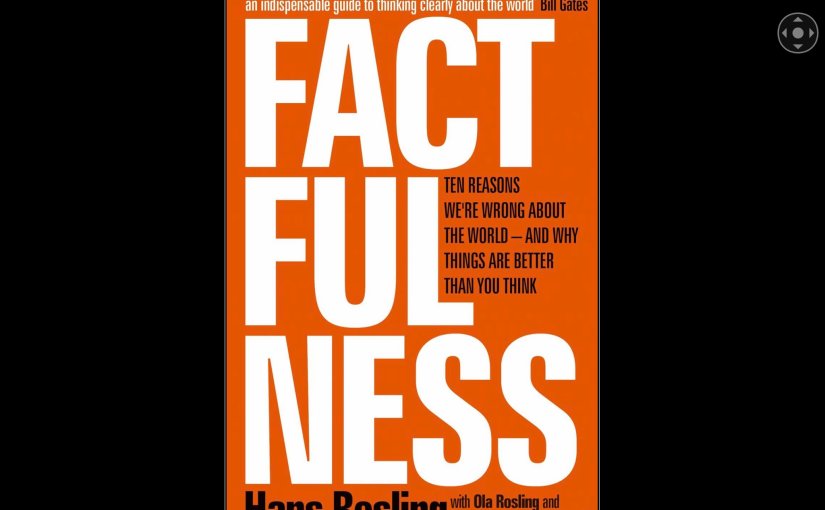
Factfulness – My Views

One book I found fascinating is “Factfullness” by the late HansRosling, Ola Rosling & Anna Rosling. The book which persuades us to look at the bright side of the World we live in. While I read this book a couple of years back I am still going ahead and posting on my blog as this is one of my favourites. 

The book is all about asking us to look at the World we live in holistically and compare the present to what was over a period of time, Of course there are many problems but we seem to be focussed only on the negatives and not looking at the positive changes we have had in many spheres of our lives.   

If we were to look at education, globally the literacy rates and people enrolled in schools has gone up – barring a few exceptions! And we seem to be focussed on these exceptions alone! I must confess I did not know and, therefore was pleasantly surprised, to see the gender gap narrowing! 

in   the past few years. 

The other aspect is the gap between fact and perception and this is no less aided by the media in building and amplifying stereotypes. I remember reading an article that showed how crime reporting increased by >600% making it look like incidences of crime were exponentially growing while in reality there was a reduction of murders per 000k of population. while there are pockets and specific events – terrorism, COVID 19 pandemic and the current Russo-Ukraine war – at an aggregate the World is a great place and it is about looking at those positives and trying to lead a more fulfilling life. And if each of us were to pick up the good then we can Truly make this planet a great one.

Taking cues from the book and Covid 19 as a case in point, there are quite a few learnings. While the pandemic, which is a once in a 100-year event, has caused quite a disruption across the globe it is important to look at event based reporting which is a serious issue too. The sudden spurt of cases and the global disruption has meant that reportage too was significantly up but the way things gotportrayed of events in India was clearly beyond acceptable and, if I may say, irresponsible. Two points here – a. the pace and success of the vaccination programme was even more out of the ordinary but the positive news that it is was nowhere comparable to all the bad news in reporting terms b. The response That we have should be replicated to other issues like say TB incidences & deaths and fatalities due to road accidents in India – with >2.5 mio cases & >450K deaths TB is a far bigger problem to solve for and with just over 1% of the world’s vehicles India accounts for ~6% of Accident based deaths (~150k) – so TB + deaths due to accidents = 1,600 deaths/day – the current action we have taken on tackling #COVID19 should be used as a learning  to handle   equally important and systemic issues.

While I knew it was important one area that is now ingrained in my thinking after reading the book is to always look for data over a period of time rather than rely on data at a given point in time; Data needs to be viewed not just over a period of time but also with other aspects such as seasonality. A simple example is to look at revenue growth over 3 years would tell us how sustainablean organisation’s growth is as against looking at growth for a year. Similarly, if we were to look at a 3-year growth for countries we will realise how in 2020 Covid did affect countries but when viewed for the next year it will also tell how countries are reacting economically.

Overall, Factfulness is a great read and one which implores everyone to look at data and the positive aspects of life and, hopefully, will make more people optimists. BTW clearly I am better than the chimps as I outscored them by answering twice as many questions correctly in the book…

Measure What Matters – My Views

OKRs, a way to set goals and measure them, have been widely used for a while now and have been gaining quite a bit of attention recently. So when a colleague, Deshbandhu Bansal, recommended that I read Measure What Matters, it was instantly on my week’s to do list! The author explains the simple yet effective way to set and measure targets through various case studies of some of the best companies in the world that have adopted the OKR methodology. Prior to reading this, I had no idea that OKRs originated from Intel and how effectively there were used.

Following are some of the things that caught my attention:

1. OKRs are quite different from regular KRAs as the objectives and specific result sets have a better correlation. What I found most fascinating was how the key result of the boss would be the objective of the person below and this would, therefore, have a clear linkage to the big picture view.

2. Another interesting thing is that OKRs can be set up for short terms such as quarterly while maintaining the overall linkage to the yearly goals.

3. A couple of case studies such as the one on Google Chrome and the other on the Bill and Melinda Gates foundation were quite interesting and reinforced the power of OKRs when implemented well.

4. Of course, the best example was of Intel and how they scored over Motorola. However, call me old school but I did not appreciate the language used by the senior management while trying to win over Motorola – aggression is good but tempering with civility is important to me.

5. The other aspect I liked was, of CFR – conversations, feedback & recognition. It was interesting to understand how we manage conversations with team members, give feedback, & how we can close the loop with recognition – assuming things go to plan on the feedback curve. 

On the work front we have begun using OKRs for measurement and the methodology was so compelling that, on the personal front, I set two OKRs for myself and am tracking them. Will keep you updated!

While the book was no doubt an interesting read, there were certain things I disagreed with too.

1. The author states that for specific objectives, success should be measured in 0/1, which I agree with. Aspirational objectives should have a stretch target and, fundamentally, should not be achieved 100% and here too I subscribe to the philosophy. However, a couple of case studies mentioned in the book did not follow the right way and I feel, should not have made into the book.

2. On CFRs, the author makes a strong case in favour of quarterly feedback. However, the author ends up painting a very black and white picture. Of course, quarterly cycles are good but to demean everything of annual cycles I feel is dramatizing things. Quarterly cycles for sure will enable more periodic feedback and will help in faster corrections, where required. But annual cycles when done with rigour work OK too and are not outright bad!

Overall a great book and I believe the thought process of OKRs could be imbibed in the way we  set goals and measure them in every sphere of life.