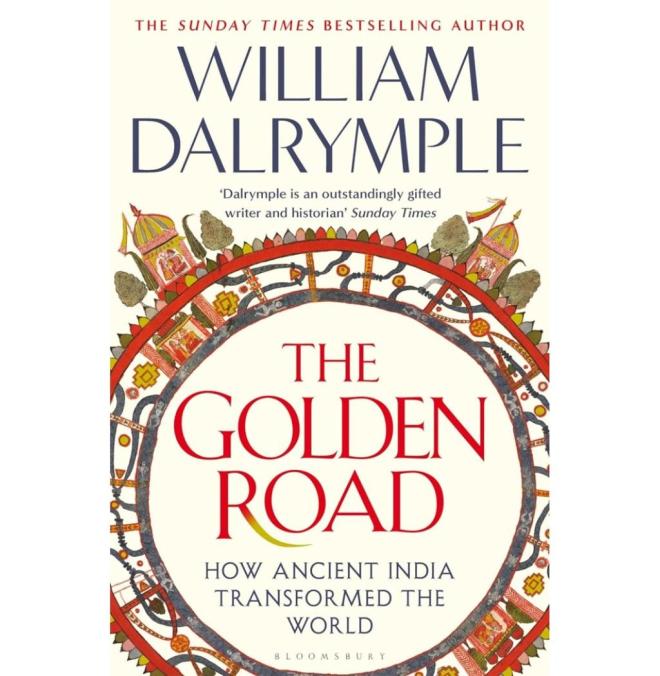
William Dalrymple is no stranger to anyone who enjoys Indian history. He is regarded by many as an authority on pretty much everything India. Of course, depending on which side of our increasingly crowded ideological divide you sit, that last sentence may either have you nodding vigorously or reaching for your keyboard.
I had read one Dalrymple before: The White Mughals. I must confess I found it rather boring and the storyline did not quite work for me. I was also uncomfortable with some of Dalrymple’s public positions over the years. The controversy surrounding Bloomsbury’s decision to withdraw Delhi Riots 2020: The Untold Story particularly rankled. Dalrymple acknowledged alerting Bloomsbury to the growing controversy around the book, although he denied asking the publisher to withdraw or ban it. So, accusing him personally of getting the book banned would be unfair. But the entire episode did little to make me reach for his next book.
What bothers me about many of these battles is the irony: self-proclaimed liberals can sometimes behave remarkably illiberally, while those branded bigots occasionally turn up asking inconvenient questions about facts and evidence.
And, so, I stayed away from his writings. Until The Golden Road. There was considerable buzz about a Dalrymple book that presented India in an extraordinarily positive light. Curiosity eventually overcame prejudice. I picked it up and finished it surprisingly quickly. Whatever else one says about him, he knows how to tell a story.
And yes, The Golden Road is emphatically a book about how India influenced the world. It ranges across an enormous period and geography, showing how Indian trade, religion, art, literature, mathematics, astronomy and culture travelled west towards Rome, east towards China and across the seas into Southeast Asia.
For Indians familiar with our civilisational history, several individual stories may already be known. For those convinced that ancient India invented everything from aeroplanes to WhatsApp, the book may provide another object to triumphantly thrust into the faces of unsuspecting dinner guests. And I confess I wondered how habitual India-baiters reacted to one of “their own” writing such an unapologetically India-positive book. And that isn’t criticism of Dalrymple. Quite the opposite.
The story begins magnificently with Ajanta and its accidental rediscovery in 1819. Dalrymple describes the extraordinary flowering of Buddhist art there, and I initially found myself questioning his emphasis. Then I realised I was wrong. I had mixed up Ajanta and Ellora.
The enormous monolithic Kailasa temple dedicated to Shiva is at Ellora, not Ajanta. Ajanta is overwhelmingly Buddhist and predates most of Ellora. Score one to Dalrymple and minus one to the reviewer!
What fascinated me instead was how Buddhism flourished so magnificently in western India, so far from the region where the Buddha lived and taught. The Buddhist and Jain presence in western and southern India is something I now want to understand much better.
Where I have been a bit uncomfortable is the suggestion, recurring through the book, that subsequent Hindu religious architecture drew substantially from earlier Buddhist architectural forms.
There certainly was influence. Buddhist rock-cut architecture predates much surviving Hindu rock-cut architecture, and techniques and forms clearly travelled between traditions. Ajanta, Ellora, Aihole, Badami and later sites cannot sensibly be viewed as hermetically sealed Buddhist, Jain and Hindu artistic universes.
But influence is different from parentage. The conceptual architecture of the Hindu temple, centred upon the garbhagriha and developing its own mandapas, shikharas or vimanas, iconography and ritual geography, cannot simply be reduced to an evolution of Buddhist architecture. What seems far more plausible to me is something characteristically Indian: different traditions borrowing, arguing, absorbing and transforming ideas from one another.
Which brings me to one of my larger problems with the book. When Dalrymple discusses Alexander’s arrival in India, there is considerable emphasis on Buddhist ascetics. Buddhism certainly existed by then. But the Greek accounts speak of both Sarmanai, or Shramanas, and Brachmanes, clearly Brahmanas. And Shramana itself does not mean Buddhist: that broad universe included Buddhists, Jains, Ajivikas and other renunciatory traditions.
Therefore, identifying India’s ascetic world of Alexander’s time too readily with Buddhism risks imposing later religious categories upon a much different reality.
This was where I began noticing something that bothered me increasingly as I read. Dalrymple’s India is unquestionably magnificent. But its magnificence sometimes seems more comfortably attributed to Buddhism and Jainism than to what he generally calls “Brahmanical” religion. Hinduism occasionally appears as an afterthought or, worse, as the somewhat less enlightened cousin that inherited and appropriated what came before.
Maybe I am reading too much into it. Or that this is subconscious rather than deliberate. But by the end of the book, I found the pattern difficult to ignore.
Consider Kanishka. He was unquestionably one of Buddhism’s great imperial patrons. Yet Kushan religious life was wonderfully pluralistic. Kanishka’s coins depict Buddha, but also a remarkable pantheon of Iranian, Greek and Indic divinities. Oesho, strongly associated iconographically with Shiva, appears prominently in Kushan coinage. His predecessor Vima Kadphises was even more strongly associated with this imagery. Why must we force these people into neat modern religious boxes when their own coins stubbornly refuse to cooperate?
Dalrymple is particularly good on something India itself has inadequately celebrated: the astonishing scale of trade between Rome and southern India. Muziris in Kerala and ports such as Arikamedu and Kaveripattinam in Tamilakam connected southern India to a commercial network stretching through the Red Sea into the Roman world. Pepper, textiles, gemstones, ivory and other Indian luxuries travelled west; Roman gold poured east.
Pliny the Elder famously complained about the amount of Roman wealth disappearing annually into India, China and Arabia to satisfy Rome’s appetite for luxuries. This deserves far more attention in our understanding of Indian history.
Where I again become cautious is when Buddhist institutions are made particularly central to these commercial networks. Buddhist monasteries undoubtedly benefited from merchant patronage, and Buddhist networks travelled along trade routes. But commerce in southern India was not somehow a Buddhist enterprise. Hindu, Buddhist and Jain communities existed within a much broader commercial and cultural ecosystem. Again, interaction seems a better explanation than ownership.
The same issue becomes particularly interesting when the Golden Road reaches Southeast Asia.
Here Dalrymple describes the remarkable spread of Indian ideas: Sanskrit, Hindu and Buddhist cosmologies, political concepts, literature, mathematics and temple architecture. The story of Kaundinya and the early Indian influence on Funan is part history, part legend and fascinating either way.
He also discusses early evidence for the zero symbol in Cambodia. This surprised me because I had always associated the earliest surviving zero with the Bakhshali manuscript. The distinction matters: the Cambodian K-127 inscription of 683 CE is among the earliest securely dated inscriptions using zero, whereas the dating and interpretation of the Bakhshali manuscript remain much more complicated than popular accounts once suggested.
But there are passages in the Southeast Asian discussion where Dalrymple’s determination to explain differences from Indian Hindu practices began to feel strained to me.
Diet is one example. If Southeast Asian communities ate foods supposedly discouraged by Hindu texts, explanations involving caste, access to scripture and subsequent disregard of scripture are introduced. But why is such an elaborate explanation necessary? More importantly, the “so-called” restrictions are not accurate too. Be it meat, fish that was supposedly banned is far from the facts!
Anyways, Indian religions travelling abroad were never photocopiers. Hinduism in Cambodia did not have to reproduce the dietary practices of a Hindu household in the Gangetic plain any more than Buddhism in China had to look identical to Buddhism in Bihar. Cultures absorb religions and then make them their own.
And this brings us, inevitably, to Manu. Dalrymple invokes restrictions attributed to the Manusmriti and other Hindu literature, including sea travel and diet. Here I think greater precision is required.
The Manusmriti does not simply say, “Hindus shall not cross the sea.” Indeed, it contains references to maritime commerce and shipping. Sea voyages could have ritual consequences in parts of the Dharmashastra tradition, and texts such as the Baudhayana Dharmasutra are considerably more explicit about this. Later caste practice turned crossing the kala pani into a serious issue in some communities.
But that complicated history is quite different from saying that Manu or the Puranas simply prohibited Hindus from travelling overseas, which was not at all the case.
Similarly, Manu regulates meat and fish consumption, prohibits foods especially for rituals and praises abstinence from meat. But turning this into a simple prohibition of fish or pork ibelieve is bordering on the disingenuous!
The position of women presents a more difficult case for someone making my argument. Manu is certainly patriarchal. Women do not enjoy equal legal and ritual status and attempts to pretend otherwise are apologetics rather than history. Having said that, applying a broad brush to the Indian society is being disingenuous too.
So, it is important to distinguish a prescriptive Dharmashastra text from the lived reality of an entire subcontinent across centuries. India contained multiple legal customs, religious traditions and social arrangements.
When Dalrymple goes on to say that people in Southeast Asia did not know Sanskrit and hence could not read the scriptures and hence did not know the injunctions, I realised the trap he was falling into his own making. He suddenly remembered that there were Brahmins who migrated too and they did know Sanskrit but according to him that was but a minor inconvenience in changing his position! I cannot help but talk about this
One of the strongest sections of The Golden Road is its account of Buddhism’s extraordinary journey into China. There is little to quarrel with in the scale of this achievement. Indian Buddhist monks, Chinese pilgrims, translators and scholars created one of history’s great intellectual exchanges.
Dalrymple also deserves credit for being unequivocal about the destruction of Nalanda and Muhammad Bakhtiyar Khalji’s role in the devastation of the great Buddhist centres of Bihar. He is refreshingly impatient with attempts to make uncomfortable historical events disappear merely because they complicate contemporary narratives. History should not require ideological air-conditioning.
And finally, Genghis Khan. Dalrymple recounts the wonderful story that Genghis contemplated invading India but turned back after encountering a rhinoceros that was interpreted as a supernatural warning. It’s a terrific story. I am just not convinced it should be treated as terrific history. The Mongols reached the Indus in 1221 because Genghis was pursuing Jalal al-Din Mingburnu, the last Khwarazmian ruler, who had escaped him after the destruction of the Khwarazmian Empire. Jalal al-Din crossed the Indus after a fierce battle and escaped into India.
There are medieval traditions concerning an extraordinary animal and an omen, and rhinoceroses could indeed still be found surprisingly far west in the subcontinent during the medieval period. So, the episode cannot simply be dismissed as zoologically impossible. But saying that a rhinoceros explains why Genghis Khan did not invade India gives an entertaining anecdote considerably more explanatory power than it deserves. Strategic objectives, logistics, climate, terrain, pasture for horses and the fact that his primary enemy had escaped are rather more important considerations. And, of course, during his rule he never went about invading without a reason – ah, but for the fun his deputies – Sebudai and Jebei had while trying to understand the faraway lands of Russia and Georgia. But there too they did not invade and occupy the lands!
I should probably stop here before this becomes The Golden Road: The Director’s Cut. Because, despite everything I have written above, I liked the book.
Dalrymple has done something valuable. He has taken a story that Indians often tell themselves and made a serious case for it to the world: for many centuries India was not sitting at the edge of global civilization. It was one of its great engines.
Indian merchants moved goods across oceans. Indian religions transformed Asia. Sanskrit became an international language of culture and power. Indian mathematics travelled west and ultimately transformed the way humanity calculates. Indian astronomy, literature, philosophy and art travelled astonishing distances without Indian armies having to conquer the countries receiving them. That is an extraordinary story, and Dalrymple tells it extremely well.
My quarrel is with the framing. At times, I felt that Dalrymple was extraordinarily comfortable celebrating ancient India’s achievements when their vehicle was Buddhist or Jain, but noticeably less comfortable when the same civilizational achievement was unmistakably Hindu or Brahmanical. Perhaps that reflects the evidence. Maybe it reflects the academic scholarship on which he relies. And just maybe some of it reflects my own biases as a reader.
But there were enough examples for the question to stay with me after I finished the book.
So, the verdict? It is a decently readable, important and India-positive book written by an author with whom I found myself arguing throughout. Which, come to think of it, may actually be one of the better reasons to read a history book.


